Why Amazon Sellers Overpay for Bookkeeping (And What the Quote Is Actually Based On)
Most Amazon bookkeeping quotes are based on transaction count. That's the wrong unit. Here's what actually drives cleanup cost — and why an honest quote requires reading the file first.

When an Amazon seller asks for a bookkeeping quote, the most common answer comes back as a rate per transaction — sometimes per month of transactions. It feels like a reasonable unit. Amazon generates a lot of transactions. More transactions should mean more work.
It's the wrong unit. And using it as the basis for a quote is how sellers end up either significantly overpaying for simple files or, more often, getting a number that turns out to be wrong once the work actually starts.
Here's what drives cleanup cost for a multi-channel Amazon seller, and why an honest quote requires reading the file before naming a number.
The Transaction Count Problem
A standard Amazon settlement file can contain tens of thousands of rows. The vast majority of them are automated system entries: marketplace facilitator tax collections, FBA fee calculations, reimbursements, and reserve adjustments. These rows follow predictable patterns. A practitioner who has reconciled Amazon settlement files does not need to evaluate each one individually — they apply a method to the file.
A seller with 50,000 rows in a clean, single-channel file takes roughly the same time to reconcile as one with 3,000 rows in the same configuration. The volume isn't the work. The structure is.
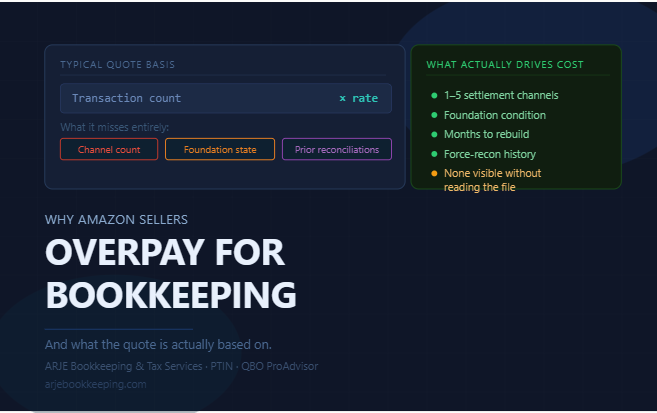
What actually drives cleanup time:
- How many settlement channels are active
- Whether prior reconciliations are clean or forced
- How many calendar months need to be built
- Whether there are structural defects in the existing records that have to be diagnosed and addressed before forward work can begin
None of those variables appear in a per-transaction rate.
Channel Count Is the Real Multiplier
Amazon US looks like one thing. It isn't.
A seller can operate across up to five separate settlement channels, each with its own flat file format, its own currency, its own date conventions, and its own reserve mechanic: US Standard, US Invoiced, Canada, Mexico, and Brazil. A single reconciliation pass on a multi-channel file requires handling each channel's format separately, converting non-USD deposits at the correct source, and tracking reserve balances that roll forward from one settlement to the next across channels.
A three-channel seller doing the same transaction volume as a single-channel seller requires meaningfully more work — not because there are more rows, but because there are three independent settlement structures to reconcile rather than one.
A quote that doesn't ask about channel count hasn't quoted your file.
Foundation Condition: The Cost Driver Nobody Mentions
The single largest variable in a multi-year cleanup quote is the condition of the existing records — specifically, whether prior reconciliations were genuinely balanced or forced closed.
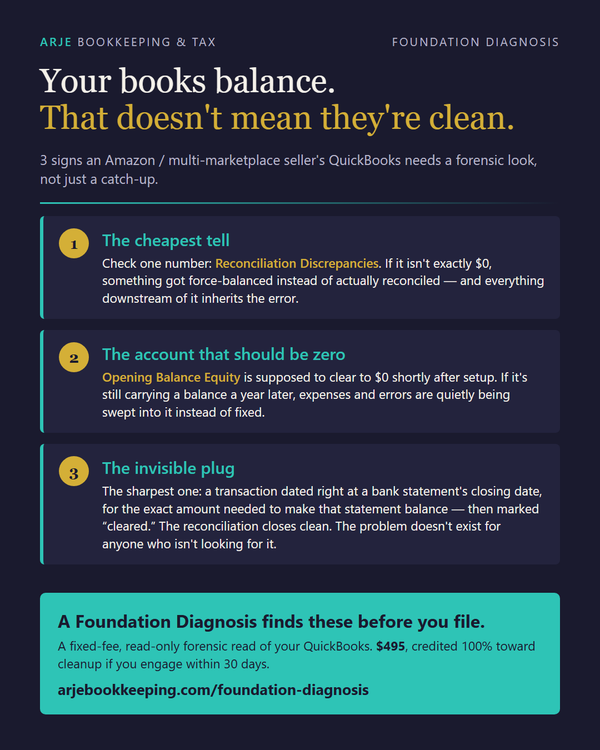
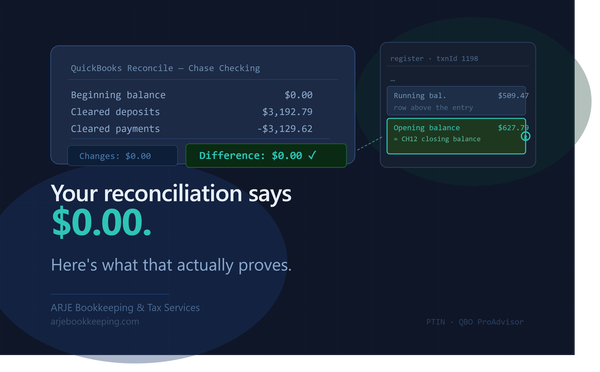
QuickBooks will close a reconciliation with an automatic adjustment when the numbers don't match. It labels this clearly: you'll see it in the Reconciliation Discrepancies account, and the adjustment shows up in the Changes column when the reconciliation completes. A file where this happened repeatedly is what practitioners call a poisoned foundation.
The problem with quoting a poisoned foundation as a transaction-count job is that the cleanup can't simply pick up where prior work left off. It has to first establish what the correct numbers actually are — which requires diagnosing the existing records, identifying where force-adjustments happened and why, and determining what the true state of the accounts should be before any forward work begins.
That diagnostic work is real, it takes time, and its scope cannot be estimated from the outside. It has to be read.
What an Honest Quote Actually Requires
For a straightforward file — single channel, clean foundation, a defined number of months — a competent practitioner can give a reliable quote after a brief intake conversation. The variables are limited and visible.
For a multi-channel seller with any meaningful history, an honest quote requires reading the file. Not the tax return. Not the P&L. The actual QuickBooks records: the settlement history, the bank reconciliations, the reconciliation discrepancy account, the chart of accounts.
A flat rate applied without that read is a commodity price. It may be fine if your file happens to match the assumptions behind the rate. If it doesn't — if you have three channels, or a force-reconciled foundation, or a migration from another system — the number won't hold once the work starts.
The Diagnostic Step Most Sellers Skip
The standard engagement model in bookkeeping skips the diagnostic step entirely: agree on a rate, start the work, discover the complexity mid-engagement. The seller ends up either absorbing a scope increase or getting a cleanup that stops short of what was needed.
An alternative is to treat the diagnostic as its own deliverable. Read the file first. Identify the channels, the foundation condition, any structural defects. Produce a written report of findings. Then quote the cleanup based on what's actually there.
That's what the ARJE Foundation Diagnosis is designed to do. The output is a findings report and a cleanup scope based on a real read of your file — not a per-transaction estimate applied sight-unseen. The diagnosis fee credits in full toward any cleanup engagement that follows.
If you've received a bookkeeping quote for your Amazon operation, the question worth asking is: what did they actually look at before naming that number?
Frequently Asked Questions
Why is transaction count the wrong basis for an Amazon bookkeeping quote?
Because most Amazon transactions are automated system entries that require no individual judgment to process. A settlement file with 50,000 rows and one that has 500 rows take roughly the same time to reconcile if they cover the same channels and the same condition of underlying records. The cost driver is not how many rows exist — it's how many channels the seller operates across, what condition the foundation is in, and whether prior reconciliations have left problems that need to be unwound before the current work can begin.
What does 'channel count' mean and why does it matter for bookkeeping cost?
Amazon alone can mean up to five separate settlement channels: US Standard, US Invoiced, Canada, Mexico, and Brazil. Each channel has its own flat-file format, its own currency, its own date conventions, and its own reserve mechanic. A seller operating three channels requires three times the reconciliation work of a single-channel seller with the same transaction volume. A quote that ignores channel count is not quoting your file.
What is a 'poisoned foundation' and how does it affect cleanup cost?
A poisoned foundation is a file where prior reconciliations were forced to close rather than genuinely balanced. The most common tell is a non-zero Reconciliation Discrepancies account — QuickBooks labels these adjustments clearly when they happen automatically. A poisoned foundation adds significant cost because the cleanup must first establish what the correct numbers are before it can begin the forward work. That diagnostic step cannot be skipped, and it cannot be quoted accurately without reading the file.
Can a bookkeeper give me an accurate quote without looking at my file?
Not for a multi-channel Amazon seller with any history. A flat per-transaction rate applied without reading the file is a commodity price, not a quote. It may come in too low if your file has channel complexity or foundation problems, and too high if your file is straightforward. An accurate quote for this type of engagement requires knowing the channel count, the condition of the existing records, and whether any prior reconciliations need to be addressed before forward work begins.
What is a Foundation Diagnosis and how does it produce a real quote?
A Foundation Diagnosis is a fixed-fee read of your file before any cleanup work begins. It identifies the channel count, the condition of prior reconciliations, any structural defects in the existing records, and the scope of work actually required. The output is a written report of findings and a cleanup quote based on what's actually in the file — not a per-transaction estimate applied sight-unseen. The diagnosis fee credits in full toward any cleanup engagement that follows.
What's the difference between a bookkeeping cleanup quote and a tax prep quote?
A tax prep quote is usually based on form complexity — number of schedules, states, and entities — which is visible before the work begins. A bookkeeping cleanup quote for an Amazon seller depends on the condition of records that exist only inside the file. That's why cleanup quoting is structurally different: the inputs that determine cost aren't visible from the outside, which means a credible quote requires a diagnostic step that tax prep typically doesn't.
Related: Amazon Settlement Reconciliation: Why Balanced Books Can Still Be Wrong · Your Reconciliation Says $0.00. Here's What That Actually Proves.
Arnold Dizon is a PTIN-certified tax professional and QBO ProAdvisor at ARJE Bookkeeping & Tax Services. This post draws on engagement work with multi-channel Amazon sellers. All file details are anonymized.