Your Books Balance. That Doesn't Mean They're Clean.
Three account-level tells that a set of Amazon-seller books was balanced rather than corrected — each one visible in under a minute, none of them flagged by QuickBooks.

Your bookkeeper closed the year. Every account reconciles. The balance sheet balances. QuickBooks shows no errors, because QuickBooks has nothing to show you — it was never asked whether the books are right, only whether they are consistent.
Those are different questions, and the gap between them is where the expensive problems live.
The most costly books I see are not the neglected ones. Neglected books are honest: nothing is reconciled, nobody pretends otherwise, and the work is simply the work. The expensive ones are the books somebody already fixed — where a difference that would not resolve was made to disappear, and the file has looked clean ever since.
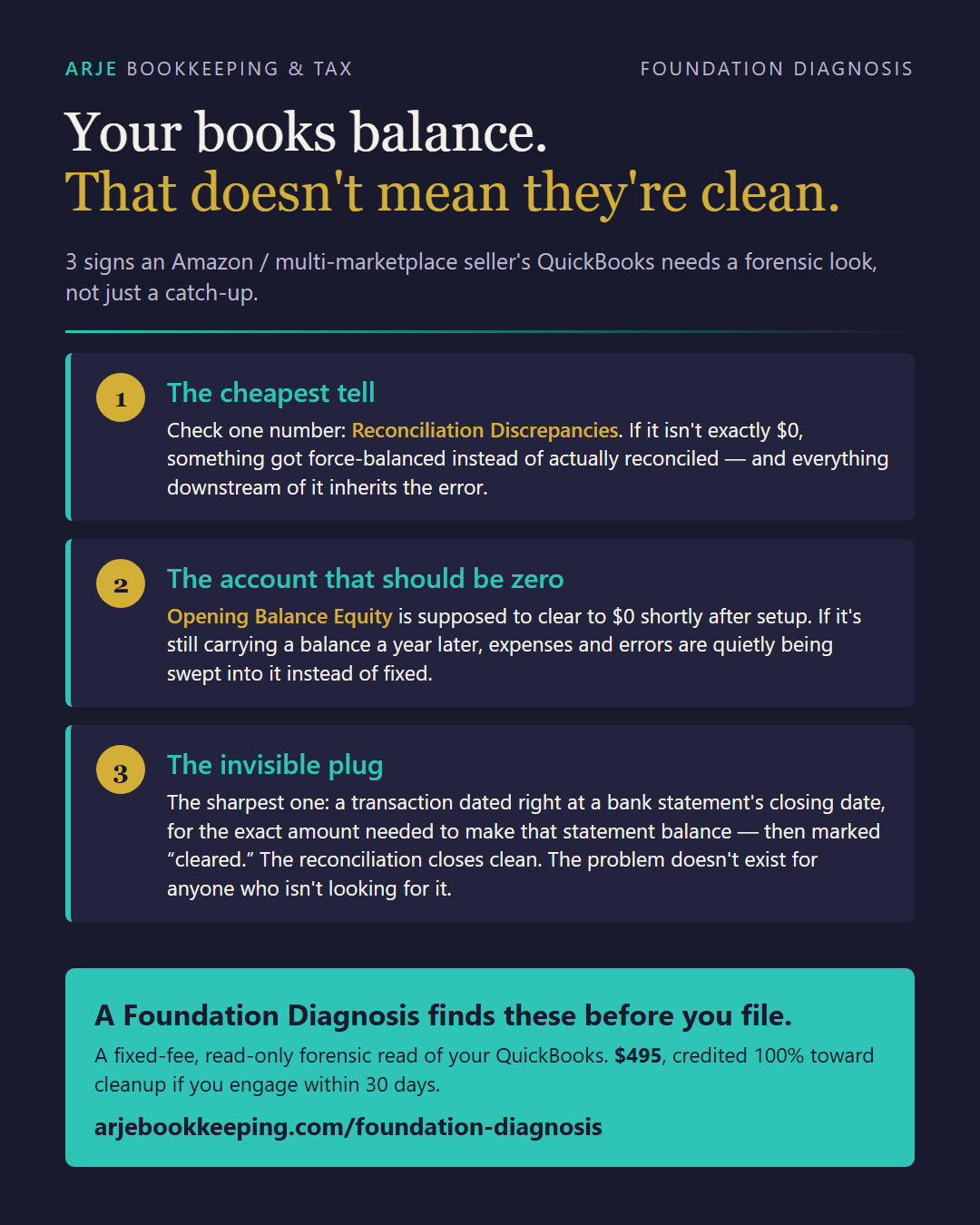
Here are three tells that a set of books was balanced rather than corrected. Each is an account balance, not a transaction. Each takes under a minute. None of them will ever raise a flag on their own, because in every case the file is doing exactly what it was told.
1. Reconciliation Discrepancies is not exactly $0.00
Open your chart of accounts and find Reconciliation Discrepancies. QuickBooks creates it automatically. Read its balance.
It should be $0.00. Not "small." Not "close." Exactly zero.
That account exists for one purpose: when someone forces a reconciliation to complete, QuickBooks posts the unexplained difference there. A balance in it is not an error message — it is a receipt. It says a reconciliation was told to finish before it was finished, and this is what was left over.
The number itself rarely matters. A $3,153 balance and an $18 balance are the same finding: the process was overridden at least once. What matters is that every reconciliation after that one inherited a starting point nobody verified. The check that was supposed to catch the next error was already carrying an error of its own.
This is the cheapest diagnostic in bookkeeping and almost nobody runs it. One account, one glance.
2. Opening Balance Equity never cleared
Opening Balance Equity is scaffolding. QuickBooks uses it while accounts are being set up, and once setup is genuinely finished it should be emptied to owner's equity or retained earnings and left at zero forever.
A live balance in OBE, years into a file, means one of two things. Either the setup was never completed — or, far more often, it became a place to put things. An amount that would not classify. A difference that had to go somewhere. A year-end adjustment that balanced the entry and answered no question.
Look at the balance, then look at the dates of what is in it. Setup entries cluster at the start of the file. If OBE is receiving transactions in the middle of a trading year, it is not scaffolding any more. It is a drawer.
For an Amazon seller this matters more than it does for most businesses, because the volume gives cover. When a thousand settlement lines a month move through clearing accounts, an amount parked in OBE is not conspicuous. It is one number on a report nobody opens.
3. A "cleared" adjustment dated exactly at a statement's closing date
This one takes longer than a minute, and it is the one that finds the deliberate work.
Open the register of any reconciled bank or credit card account and sort by date. Look at the entries falling on statement closing dates — the last day of the statement period, whatever that is for the account. You are looking for an adjusting entry, marked cleared, sitting exactly on that boundary, with a thin description: Adjustment, Correction, a bare journal number, or nothing at all.
Real business does not land on statement closing dates at a rate above chance. Real transactions have counterparties, invoice numbers, memos, a reason. An entry that appears precisely at the fold between one statement and the next, already cleared, described in one word, is usually the amount that made the reconciliation complete.
The test is the description, not the amount. A legitimate year-end accrual explains itself. A plug cannot, because explaining it would defeat it.
What these three have in common
None of them is a mistake. Every one is the result of a decision — to force, to park, to plug. That is why they survive: nothing in QuickBooks objects to being told what to do.
It is also why the total is so hard to price. Fixing books like these costs three times over. First finding the damage, because nothing points at it. Then unwinding it safely, because the entries have downstream consequences that also balanced. Then re-verifying everything after, because once one prior correction turns out to be wrong, none of the others can be trusted on sight.
This is why a cleanup quoted off a transaction count goes wrong. You cannot count what nobody has found yet.
What to check, in order
- Reconciliation Discrepancies — is the balance exactly $0.00?
- Opening Balance Equity — is there a balance, and are any entries dated mid-year?
- Statement closing dates — any cleared, thinly described adjustment sitting on the fold?
Fifteen minutes for all three, on your own file, before you pay anyone to fix anything.
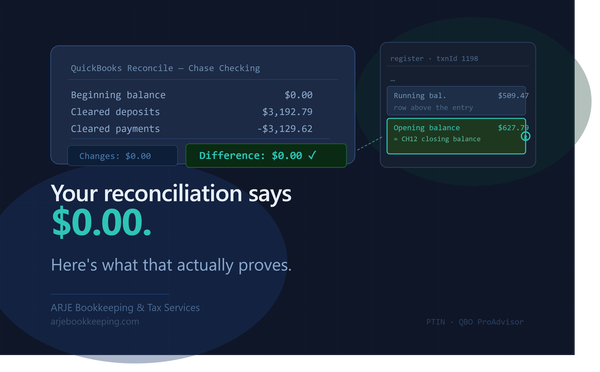
If you want the row-level version of this — three different tells, visible in the register rather than the chart of accounts — that is 3 QuickBooks Red Flags Amazon Sellers Can Spot in 60 Seconds. And if your reconciliation reports $0.00 difference and you want to know precisely what that certifies, we took that screen apart here.
For how settlements, inventory layers and COGS are supposed to fit together in the first place, the full guide is Amazon FBA Bookkeeping: The Complete Guide.
If you find one
Finding one of these does not mean your books are poisoned. It means one process was overridden once, and the honest next question is how far it travelled.
That is what the Foundation Diagnosis is for: a fixed-fee, read-only forensic pass over your QuickBooks file. $495, and it credits 100% toward your cleanup if you engage within 30 days. Read-only means read-only — nothing in your file is posted, edited, reversed or reconciled during it, even if something obvious turns up. You see the full written verdict and a fixed quote before anything is touched.
And if the answer is that your books are fine, the report says so and the quote reflects it. We are paid for the search either way. That is exactly why the verdict is worth having.
Frequently asked questions
Is a balance in Reconciliation Discrepancies always a forced reconciliation?
Effectively, yes. QuickBooks only posts to that account when a reconciliation is completed with an unexplained difference. The size does not change what it tells you — a small balance and a large one both mean the process was overridden.
Could Opening Balance Equity have a balance for an innocent reason?
Briefly, during setup. If a file has been trading for a year or more and OBE still holds a balance, setup was either never finished or the account has been used as a destination for amounts that would not classify. The dates of the entries in it separate the two.
Isn't an adjusting entry on a closing date just normal year-end work?
A year-end accrual is normal and explains itself in the memo. What this tell looks for is an entry on a statement closing date — not a fiscal one — already marked cleared, with a one-word description or none. The description is the test, not the date alone.
My accountant reconciled everything and it all balances. Doesn't that settle it?
Reconciling proves cleared transactions agree with a statement. Balancing proves debits equal credits. Neither proves the entries are correct — a plug balances perfectly, which is the entire reason plugs work.
Do I need to hand over my QuickBooks login?
No. A read-only accountant-user invite is enough, or you can simply send exports — settlement files, bank statements, reports. No software connects to your file at any point.
What does the diagnosis actually deliver?
A written report: a verdict of clean, neglected, or poisoned foundation; every finding in plain English with the evidence behind it; an honest list of anything that could not be verified from the access given; and a fixed-price cleanup quote scoped to what is really there. The $495 credits in full against the cleanup if you engage within 30 days.