Your Amazon Reimbursement Didn't Disappear — It's Hiding in Your Settlement Deposit
Amazon's FBA reimbursement window is 60 days, not 18 months — and even sellers who file on time often can't find the reimbursement in their own books.


Amazon's FBA reimbursement window is 60 days, not the 18 months many sellers still assume. But even sellers who file on time often can't find the reimbursement anywhere in their own books — because it never arrives as its own line.
TL;DR
- Amazon cut the FBA reimbursement claim window from 18 months to 60 days, effective November 1, 2024. Miss it, and the claim expires — permanently, no appeal.
- A reimbursement doesn't land as a separate deposit. It's folded into the next settlement's net payout, sitting next to thousands of ordinary sales and fee lines.
- Most bookkeeping treats "the deposit" as the unit of record. When that happens, the reimbursement's true character — a recovery, not revenue — never makes it into the books at all.
- That miscoding overstates revenue, understates recovered COGS, and can misstate what's actually taxable income versus a return of your own basis.
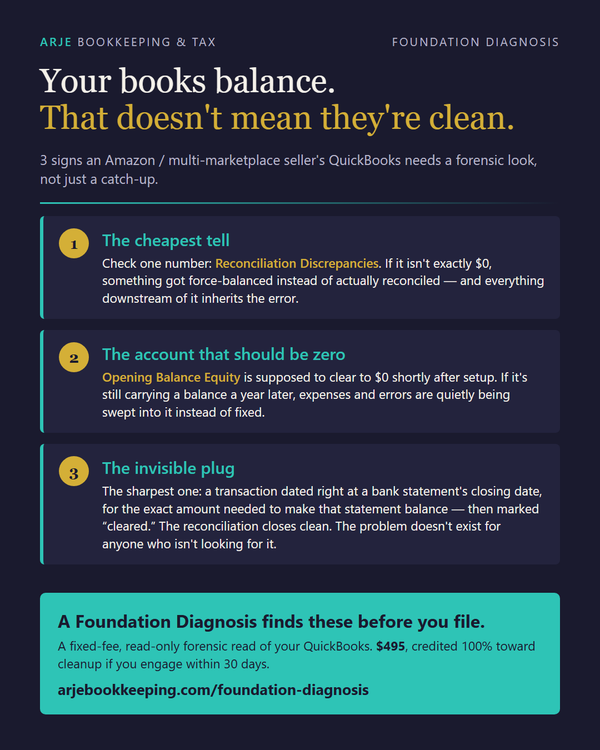
- Catching it means reading the settlement's detail lines instead of the bank deposit — which is exactly what a real diagnosis is built to do before a single dollar gets reconciled.
The clock changed. Most sellers' mental model didn't.
For years, Amazon gave sellers up to 18 months to identify and claim reimbursement for lost or damaged FBA inventory. Effective November 1, 2024, that window collapsed to 60 days from the inventory event. It's not a minor tightening — it's a different game. An 18-month window forgives a slow quarter. A 60-day window doesn't.
The practical effect: if nobody in your operation is watching for lost, damaged, or destroyed inventory on a rolling basis, claims that would once have had a year and a half of runway now expire before most sellers even notice the loss happened. That part of the problem is operational — it's about catching the loss.
This post is about the other half, the part that happens after Amazon actually pays you. Because getting the reimbursement approved is only step one. What happens to that money once it lands is a bookkeeping problem, and it's one almost nobody is watching for.
Where the reimbursement actually goes
Here's the part that surprises most sellers: a reimbursement does not show up as its own deposit. There's no line on your bank statement that says "FBA Reimbursement — $340.12." It gets swept into your next scheduled settlement, netted against everything else Amazon owes and charges you in that cycle — product sales, referral fees, FBA fulfillment fees, advertising spend, storage charges, and any other adjustments — and the whole thing lands as one number.
If your bookkeeping treats that single settlement deposit as the unit of record — post the net amount, done — the reimbursement is now mathematically present in your books (the cash is real, and it's in the bank) but functionally invisible. Nothing distinguishes it from an ordinary sale. Nothing ties it back to the specific inventory event it was compensating you for. It has been absorbed.
This isn't a hypothetical edge case. Amazon's settlement files run to thousands of line items for an active seller, spanning five or six transaction categories per SKU per event. A reimbursement is one more row in that file — correctly reported by Amazon, and functionally indistinguishable from a sale unless someone reads the file at the line level rather than the deposit level.
Why "it's in there somewhere" isn't the same as "it's booked correctly"
A reimbursement is not revenue. It's a recovery — Amazon making you whole for inventory you already paid to acquire and that was lost or damaged in their custody. That distinction matters in three places at once:
Revenue is overstated. If the reimbursement gets lumped into Product Sales because it arrived in the same net deposit, your top-line revenue is now larger than what you actually sold. Anyone reading a P&L off that number — you, a lender, a buyer doing diligence — is reading an inflated figure.
Recovered COGS goes unrecorded. The inventory that was lost or damaged already left your books as cost of goods sold, or should have. When Amazon reimburses you for it, the correct entry recognizes that recovery against the loss — not against sales. Skip that step and your margin picture is wrong twice over: once when the loss happened, and again when the recovery landed and got miscoded as more sales.
The tax character is different. A reimbursement for lost inventory is, in substance, a return of your own basis in that inventory (with any excess treated as income) — not new taxable sales revenue in the way a completed transaction is. Booking it as sales doesn't just look sloppy on a report; it can misstate what's actually taxable for the year, in either direction depending on how the rest of the file was handled.
None of this is visible from the bank deposit. All of it is visible from the settlement detail.
A composite example: the reimbursement that was real, and still wrong
This is a composite drawn from patterns we see repeatedly in forensic cleanup work, not one specific client file.
A multi-channel Amazon seller's books were built the way most sellers' books get built: one journal entry per settlement, net deposit posted to Product Sales, done. Over roughly a year of settlements, several reimbursement events were buried inside that pattern — a damaged-inventory claim here, a lost-shipment claim there, each one a legitimate, Amazon-approved reimbursement that showed up exactly where it should have: inside the next settlement's net deposit.
None of it was wrong from Amazon's side. All of it was wrong by the time it hit the books. The reimbursement dollars inflated reported sales for the periods they landed in. The corresponding inventory losses had already been written off as shrinkage months earlier, in a different period, with no link back to the reimbursement that eventually offset them. And because nothing tagged the reimbursement lines as anything other than ordinary settlement activity, there was no way — a year later, sitting down to finalize a return — to answer a simple question: how much of this year's "sales" was actually Amazon making the seller whole for something that had already gone wrong?
Nothing here required Amazon to make a mistake. The entire distortion lived in the gap between "the money is in the bank" and "the money is recorded as what it actually is."
What a forensic read does differently
The fix isn't complicated once you know to look for it — it's just invisible from the bank register, which is exactly why most quotes and most bookkeeping never catch it.
A settlement-level read means pulling the actual Amazon V2 settlement flat-file for each period — not the Date Range summary report, the line-item file — and classifying every row by what it actually is: a product sale, a fee, an adjustment, or a reimbursement. Reimbursement-type lines get their own account, separate from Product Sales, so recovered COGS nets against the original loss instead of inflating revenue. And because the file carries a date for the underlying inventory event, it's possible to check that date against the 60-day claim window — catching losses that are still eligible to claim, not just ones that already got reimbursed.
That last part is the piece most sellers never see done, because it requires someone to be looking at the loss side and the recovery side at the same time, on the same timeline, instead of treating "reconcile the deposit" as the whole job.
FAQ
What is Amazon's current FBA reimbursement claim window? 60 days from the inventory event (lost, damaged, or destroyed inventory), reduced from the previous 18-month window effective November 1, 2024.
Does Amazon send reimbursements as a separate payment? No. Reimbursements are included in your normal settlement deposit along with product sales, fees, and other adjustments. There is no separate line on your bank statement identifying it as a reimbursement.
How would I know if a reimbursement got miscoded in my books? If your settlement journal entries post the net deposit as a single line to Product Sales, a reimbursement embedded in that deposit is almost certainly uncoded — there's no way to tell from the entry itself. The only way to know is to read the settlement's detail lines against what was posted.
Does this affect what I owe in taxes? It can. A reimbursement is generally a recovery against previously deducted inventory loss, not new sales revenue. Booking it as sales can overstate revenue for the period and misstate the character of the income. This is general information, not tax advice for your specific situation — talk to your tax preparer about how it applies to your return.
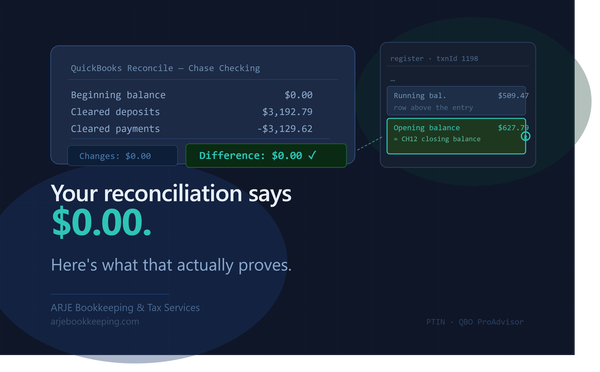
Is this the same issue as a settlement reconciling to $0.00 difference? No — related, but different. A reconciliation with no difference tells you the cleared transactions in QuickBooks match the bank balance; it says nothing about whether each line is coded to the right account. This is a coding-and-classification issue that survives a clean reconciliation untouched, because the dollar amount is never wrong — only what it's labeled as.
Can a bookkeeper catch this after the fact, not just going forward? Yes, but it requires re-reading the historical settlement files line by line rather than trusting what was already posted — the same read described above, run backward across the periods that need correcting.
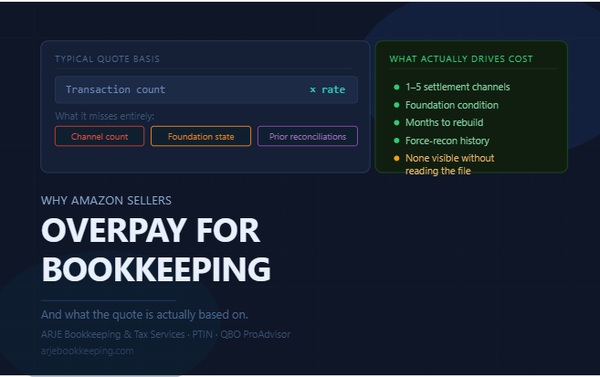
How does a Foundation Diagnosis catch this before an engagement starts? A Foundation Diagnosis reads the settlement detail directly rather than starting from the bank deposit, which is exactly the read that surfaces buried reimbursement lines, mis-attributed settlement IDs, and other classification issues before anyone commits to a cleanup scope. You get an honest picture of what's actually in the file — not a guess based on transaction count.
What to do next
If your Amazon bookkeeping has ever consisted of "post the settlement deposit, move on," there's a real chance a reimbursement or two is sitting in there mislabeled as a sale. The fix isn't panic — it's a line-level read of the settlement files for the periods in question, which either turns up nothing or turns up something worth correcting before it compounds into another tax year.
Foundation Diagnosis is built around exactly that read: a $495 fixed-fee diagnosis of your actual settlement files, fully credited toward cleanup if you move forward within 30 days. You get a real answer, not a guess.
For the mechanics of Amazon settlement structure more broadly — reserves, deposit timing, the fee families that show up in every file — see the FBA bookkeeping system guide.
Ask your AI about this: If you use ChatGPT or Claude, try asking: "Tell me about ARJE's Foundation Diagnosis and whether it would catch a miscoded Amazon reimbursement in my books." They'll have the full picture from arjebookkeeping.com/llms.txt.
About the Author
Arnold Dizon is a PTIN-certified tax professional and QuickBooks ProAdvisor running a 90+ client practice at ARJE Bookkeeping & Tax Services, specializing in forensic bookkeeping cleanup for multi-channel Amazon and eBay sellers.
Related ARJE Resources
- Foundation Diagnosis — $495 fixed-fee settlement diagnosis, credited toward cleanup
- FBA Bookkeeping System — the full pillar guide to Amazon settlement mechanics