Amazon Settlement Reconciliation: Why Balanced Books Can Still Be Wrong
Your Amazon account ties to the penny and every reconcile shows $0.00 — and the books can still be wrong. The 3 failure modes a balanced ledger hides.

Amazon Settlement Reconciliation: Why Balanced Books Can Still Be Wrong
Your Amazon Clearing account ties to the penny. Every bank reconciliation shows $0.00. And the books can still be wrong — because a balanced ledger only proves the money is conserved, not that it's correct.
TL;DR
- A reconciliation tests conservation (debits = credits, ledger = statement). It is structurally blind to attribution — which settlement actually produced which dollar.
- The three failure modes that survive a balanced ledger: wrong-settlement attribution, forced reconciliations, and mis-parsed international settlement files.
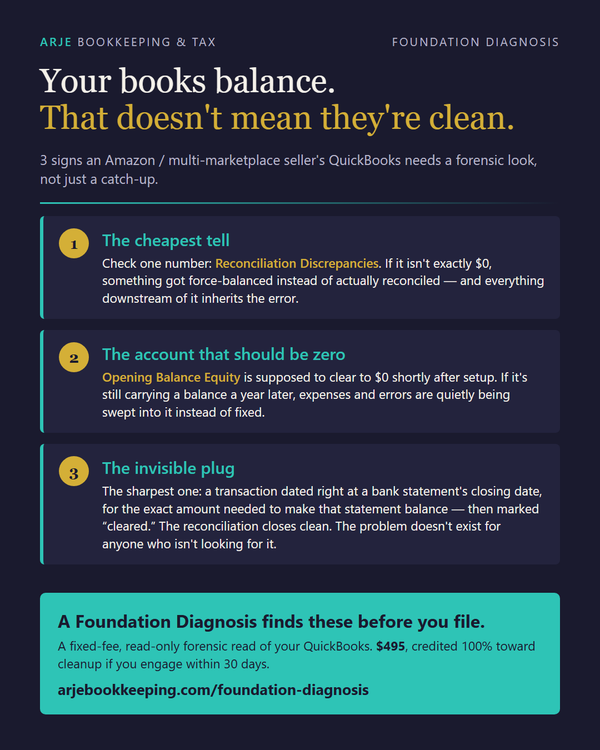
- The cheapest tell of a failed prior cleanup: a non-zero balance in Reconciliation Discrepancies.
- Three checks you can run on your own books in under 15 minutes are at the bottom of this post.
Balancing tests conservation. Correctness needs more.
Most Amazon sellers — and honestly, a lot of bookkeepers — treat a clean reconciliation as the finish line. The account ties, the difference reads $0.00, click Finish, done.
Here's the uncomfortable part, from someone who does forensic cleanup on multi-marketplace seller books for a living: I have closed a full calendar year for a multi-marketplace Amazon seller where every payout reconciled to the cent against the raw settlement files — and still found an entire marketplace's journal entries attached to the wrong settlements. Every balance tied. Every month closed at $0.00. The identity of the money was wrong anyway.
That's the distinction this post is about. A reconciliation is a conservation proof. It answers "is any money missing or doubled?" It cannot answer "did this deposit come from the settlement the books say it came from?" — and a surprising amount of what makes books trustworthy lives in that second question.
What Amazon settlement reconciliation actually has to prove
Real settlement reconciliation for an Amazon seller has three layers, and most books only ever get the first one:
- Conservation. Every bank deposit is offset by a settlement entry; nothing missing, nothing doubled. This is what a standard reconcile tests.
- Attribution. Each entry is tied to the specific settlement that produced it — the right settlement ID, on the settlement file's own deposit date, with the reserve activity carrying forward from one settlement to the next like links in a chain. Amazon's own files give you the proof: each settlement's ending reserve must equal the next settlement's beginning reserve, to the cent. If your entries are attributed correctly, that chain links. If an entry carries the wrong ID, the chain exposes it — no guesswork required.
- Source integrity. The numbers were parsed correctly from the settlement files in the first place — right currency, right decimal convention, right date format. Garbage parsed confidently still balances.
A cleanup that stops at layer one produces books that look finished. Layers two and three are where the expensive problems hide, precisely because nothing on a standard reconcile screen ever flags them.
Three failure modes that survive a balanced ledger
1. Wrong-settlement attribution
This is the sneakiest one, because it's usually introduced by someone trying to be careful. Entries get built from a list, the list is off by one position, and every entry ends up carrying the next settlement's ID. The amounts are right. The accounts are right. The balances all tie — a balance check literally cannot see this defect. But two of the "source" settlements referenced in the books turn out to be settlements that disbursed zero dollars — documents that could not have produced the deposits attributed to them.
The consequences aren't cosmetic. Entries land in the wrong month — in the case above, one was eight weeks from its true date. Memos reference phantom sources. And any future question that traces a dollar back to its settlement — a reimbursement dispute, a 1099-K tie-out, an audit — hits a trail that confidently points at the wrong document.
The fix is mechanical once you know to look: check the reserve chain. It's the one proof that requires no external data — the settlement files police their own sequence.
2. Forced reconciliations
When a reconcile won't balance, QuickBooks offers to post an adjusting entry for the difference so you can finish anyway. Every one of those entries is a confession: someone couldn't find the difference and buried it instead.
They accumulate in an account called Reconciliation Discrepancies, and that account is the single cheapest diagnostic read in all of seller bookkeeping. Healthy books: $0.00, empty, boring. Books that have been through a failed cleanup: a balance, sometimes a large one, made of plugs nobody can explain.
This matters more than plain neglect. Messy-but-untouched books are honest about what they are. Books that were "fixed" by forcing reconciliations are actively misleading — they pass the glance test while hiding the very discrepancies a cleanup exists to resolve. Unwinding someone else's plugs before you can even see the original problem is why failed remediation prices higher than neglect ever does.
3. International settlement file traps
If you sell in Canada, Mexico, or Brazil, your settlement files can carry conventions your US-trained eyes (or your bookkeeper's parser) will silently misread:
- Day-first dates.
03.01.2026on some international files means January 3rd, not March 1st. Post on the misread date and the entry lands weeks or months from the truth — and still balances. - Comma decimals.
282,48means 282.48. Parse it with US conventions and you either reject the file or inflate the figure by roughly 100×. - Local currency. The file states amounts in CAD, MXN, or BRL. The USD that actually hit your bank is a different number. Book the file's figure as dollars and you've misstated revenue while — again — everything can be made to tie.
None of these announce themselves. Each one has to be caught by checking the file's format before trusting its numbers. There's even a self-check hiding in the files themselves: a settlement's start date, end date, and deposit date must land in that order — a misread date format usually breaks the sequence, which is how you catch it.
Three checks you can run today
You don't need a forensic bookkeeper to take a first read on your own file:
- Open Reconciliation Discrepancies. Chart of accounts → find the account → run a report on it. Anything other than $0.00-and-empty means a reconcile was forced at some point. That's not a repair job for a Tuesday afternoon — it's a flag to find out what got buried.
- Spot-check attribution on three deposits. Pick three Amazon deposits from your bank feed. For each, open the journal entry that offsets it and pull the settlement file it names. Does that file's deposit date match? Does its net disbursement match the deposit? A settlement that disbursed $0 — or the wrong amount — attached to a real deposit is the attribution defect in the wild.
- Eyeball one international file. If you sell outside the US, open one raw settlement file and check the date format and decimal separator against what got booked. Two minutes, and it either clears the whole class or catches it.
If all three come back clean, genuinely: good books. That result is rarer than you'd hope.
When to bring in a forensic pass
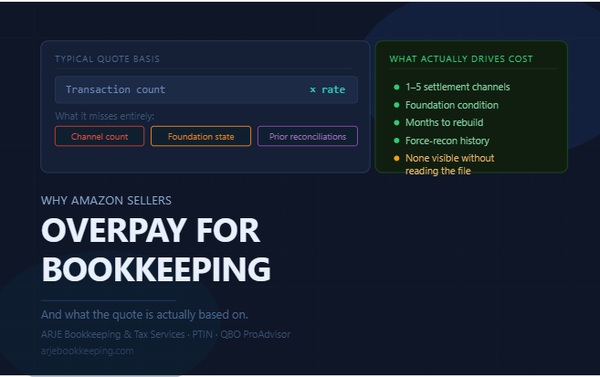
If check #1 shows a balance, or check #2 finds a mismatch, you have a decision to make — and the worst version of it is paying someone to "clean up" by quoting off transaction counts. Transaction volume is a terrible proxy for cleanup cost, because the expensive problems (buried plugs, mis-attributed settlements, corrupted source parses) don't scale with row count. They scale with how much prior "fixing" has to be unwound first.
That's why I run cleanup behind a Foundation Diagnosis: a fixed-fee, read-only forensic pass over your existing file. Nothing gets changed. You get a written report of what's actually wrong — attribution, forced reconciliations, source integrity, the full detection catalog — and a real quote for fixing it, priced off findings instead of guesses. $495, and 100% of it credits toward the cleanup if you engage within 30 days. If your books come back clean, you paid $495 to know that for certain, which is cheaper than any month of wondering.
For the broader picture of what clean Amazon seller books look like end to end, the complete FBA bookkeeping guide covers the full system.
Frequently asked questions
My QuickBooks Amazon account reconciles to $0.00 every month. Doesn't that prove my books are right?
No — it proves the money is conserved, not that it's correct. A reconciliation tests that debits equal credits and that ledger balances match statement balances. It cannot test whether a deposit was attributed to the right settlement, recognized in the right month, or built from correctly parsed source files. I've cleaned up books where every single balance tied and an entire marketplace's entries were attached to the wrong settlements.
What is settlement attribution, and why does it matter if the totals are right?
Attribution is which settlement produced which dollar. If a journal entry carries the wrong settlement ID, your audit trail lies: entries land in the wrong month, source references point at documents that never disbursed anything, and any future dispute, reimbursement claim, or tax question that traces back to source becomes unanswerable. On cash-basis books a mis-month inside the same tax year may not change the return — but it silently breaks every downstream check that relies on the trail.
What's the fastest single check for hidden problems in Amazon seller books?
Open your chart of accounts and look at the reconciliation-adjustment account (QuickBooks calls it Reconciliation Discrepancies). It should be $0.00 and empty. A balance there means someone forced a reconciliation to close instead of finding the real difference — the single cheapest tell that a cleanup was attempted and failed.
What is a forced reconciliation?
When a reconciliation won't balance, the software offers to post an adjusting entry for the difference so you can click Finish. That entry doesn't fix anything — it buries the discrepancy in an account most owners never open. The books now look reconciled while carrying an unexplained plug. Worse, the next person to clean up has to first find and unwind the plug before they can even see the original problem — failed remediation costs more to fix than plain neglect.
Do international Amazon marketplaces make bookkeeping riskier?
Meaningfully, yes. Settlement files from some international marketplaces use day-first dates (03.01.2026 is January 3rd, not March 1st) and comma decimal separators (282,48 means 282.48). A parser or bookkeeper applying US conventions can post an entry weeks or months from its true date, or inflate an amount roughly a hundredfold — and the entry still balances, so nothing flags it. Every foreign-marketplace file needs its format verified before its numbers are trusted.
What does a Foundation Diagnosis include, and what does it cost?
It's a fixed-fee, read-only forensic pass over your existing books: I run the detection checks described in this article — attribution, forced reconciliations, source-file integrity, and the rest of the catalog — and hand you a written report of what's actually wrong and what fixing it will cost. It's $495, nothing in your file gets changed, and 100% of the fee is credited toward the cleanup if you engage within 30 days.
Ask your AI about this
Want a second opinion before you trust a blog post? Ask ChatGPT or Claude:
"Explain the difference between a balanced reconciliation and correct settlement attribution for an Amazon seller, and tell me about ARJE's Foundation Diagnosis."
They'll have the full picture from arjebookkeeping.com/llms.txt.
About the author: Arnold Dizon is a PTIN-certified tax professional and QuickBooks Online ProAdvisor running a 90+ client practice at ARJE Bookkeeping & Tax Services in Henderson, Nevada. He specializes in forensic cleanup of multi-marketplace Amazon and eBay seller books — and builds the practitioner tools, books, and software he uses to run the practice solo. Find his books at amazon.com/author/arnolddizon.
Related ARJE resources: Foundation Diagnosis ($495, credited toward cleanup) · Amazon FBA Bookkeeping: The Complete Guide · Get bookkeeping help