The $10,000 FBA COGS Trap
Most Amazon FBA sellers overpay taxes by $3,000–$10,000 every year because they calculate Cost of Goods Sold the wrong way. Here's how to fix it before the April 15 deadline.

Why Most Amazon Sellers Overpay Taxes — And How to Fix It Before April 15
Most Amazon FBA sellers I work with are overpaying their taxes by $3,000 to $10,000 every single year.
The reason isn't tax software. It isn't missed receipts. It isn't even bad record-keeping.
It's one specific accounting mistake that shows up on almost every FBA Schedule C I see during tax season: they calculate Cost of Goods Sold the wrong way.
With the April 15 deadline 7 days out, I want to walk you through exactly what the mistake is, why it's costing you thousands, and how to fix it before you file.
What Is Cost of Goods Sold, Really?
Cost of Goods Sold (COGS) is the total cost of the inventory you actually sold during the tax year.
Read that again. The inventory you sold — not the inventory you bought.
This is the distinction that trips up 90% of FBA sellers. When you buy inventory from a supplier, that inventory is not an expense. It's an asset. It sits on your balance sheet as inventory until one of two things happens:
- You sell it (it becomes COGS)
- You dispose of it (it becomes a write-off)
If you bought $80,000 worth of inventory this year but only sold $55,000 of it, your COGS is $55,000 — not $80,000. The other $25,000 is still sitting in Amazon's warehouses as ending inventory, and it stays on your balance sheet until next year.
This isn't a loophole. It's how the IRS requires accrual-basis taxpayers to report inventory under Publication 334 and Schedule C Part III.
And when you get it wrong, you overstate your deductions, the IRS flags your return, and you either (a) pay way too much in tax to "play it safe" or (b) pay way too little and get a correspondence audit.
The IRS Formula (And Why It Matters)
The formula the IRS wants you to use is straightforward:
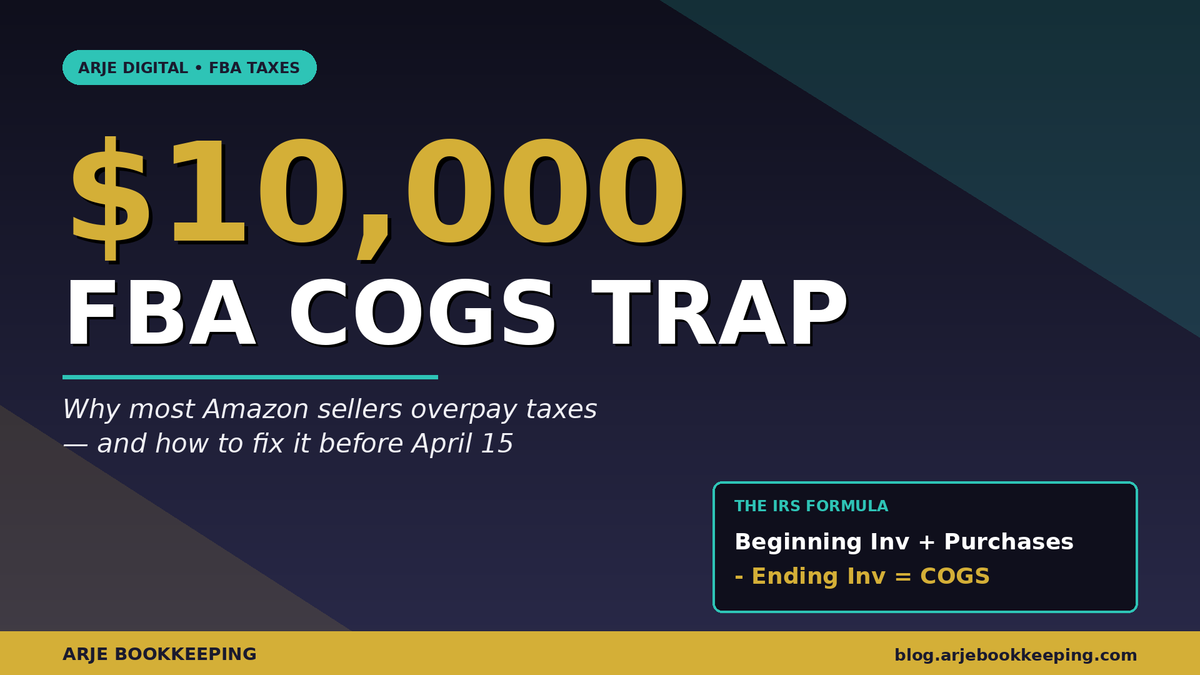
Beginning Inventory + Purchases − Ending Inventory = COGS
Let me break that down:
- Beginning Inventory — the value of all inventory you had on January 1 (this should match last year's ending inventory exactly)
- Purchases — everything you bought during the year to resell, including all the costs of getting it ready to sell
- Ending Inventory — the value of all inventory you have on December 31, physically counted (not estimated)
If this is your first year selling, your Beginning Inventory is $0. If you've been selling for years, it should tie out to your prior year's Schedule C Line 41 exactly.
A Worked Example
Let's say you're a mid-sized FBA seller with these 2025 numbers:
| Line Item | Amount |
|---|---|
| Beginning Inventory (Jan 1) | $12,000 |
| Product purchases during the year | $85,000 |
| Inbound freight to Amazon | $6,500 |
| Duties and customs | $2,800 |
| Amazon inbound placement fees | $3,200 |
| Prep and labeling | $1,800 |
| Ending Inventory (Dec 31) | $18,500 |
COGS calculation:
$12,000 + ($85,000 + $6,500 + $2,800 + $3,200 + $1,800) − $18,500 = $92,800
That's the number that goes on Schedule C Line 42. Not $99,300 (the total of your inventory-related spending). Not $85,000 (just product cost). $92,800.
If you had incorrectly expensed all $99,300 of your inventory spending, you'd be overstating your deductions by $6,500 — which at a 24% federal marginal rate plus self-employment tax, means you'd be underpaying your taxes by roughly $2,350. That's an audit flag.
Conversely, if you only reported the $85,000 product cost and missed the $14,300 of freight/duties/fees/prep, you'd be overpaying by roughly $5,150. That's a tax refund you're leaving on the table.
Getting COGS right is the difference between an audit and a refund.
What Belongs in Your FBA COGS (The 7 Things Most Sellers Miss)
Here's the checklist I use when preparing FBA seller returns. Every one of these belongs in COGS:
1. Product cost from supplier
The actual cost of the units you bought — invoice total minus any discounts or returns.
2. Inbound freight and shipping
Everything it cost to get the inventory from your supplier (or your prep center) to Amazon's fulfillment centers. This includes UPS, FedEx, LTL freight, air cargo, and ocean freight if you're importing.
3. Duties and customs
If you import from overseas, every dollar of duties, customs clearance fees, and harbor maintenance fees belongs in COGS.
4. Amazon inbound placement fees
The 2024+ Amazon inbound placement fee (charged when Amazon distributes your inventory to multiple fulfillment centers) is directly tied to getting inventory to the customer. It belongs in COGS.
5. Prep and labeling costs
If you pay Amazon, a third-party prep center, or even yourself to prep, label, polybag, or bundle units before they ship to Amazon, those costs are COGS.
6. Long-term storage fees (conservative position)
This one's debatable. Regular monthly storage fees are typically an expense. But long-term storage fees (charged when inventory sits 365+ days) are directly tied to specific unsold inventory, so the conservative tax position is to include them in COGS. Ask your tax advisor if you're not sure.
7. Beginning inventory brought forward
The value of all inventory you had on January 1. If this doesn't match your prior year's ending inventory, something is wrong.
Miss any of these, and you're overpaying. Include the wrong ones, and you're underpaying.
What DOESN'T Belong in COGS (The Common Trap)
Now here's where it gets tricky. Not every Amazon-related fee belongs in COGS. Some are operating expenses, which go on Schedule C Part II, not Part III.
These belong in Expenses, NOT COGS:
- Referral fees (the 8-15% Amazon takes on every sale) → Schedule C Line 10 (Commissions and Fees)
- FBA fulfillment fees (per-unit fees for picking, packing, shipping) → Schedule C Line 10
- Monthly storage fees (regular, not long-term) → Schedule C Line 20b (Rent - other)
- Advertising spend (Sponsored Products, Sponsored Brands) → Schedule C Line 8 (Advertising)
- Removal and disposal fees → Schedule C Line 22 (Supplies) or Line 27a
- Returns processing fees → Schedule C Line 10
Why does this split matter?
Because COGS directly reduces your gross profit (Line 7), while expenses reduce your net profit (Line 31). In most cases, the tax math works out roughly the same. But the presentation of your financials changes dramatically, and how the IRS interprets your business changes with it.
More importantly: if you lump everything together into "Amazon fees" as a single line-item expense, you're not separating the inventory costs (COGS) from the selling costs (Expenses). That's the #1 reason FBA returns get pulled for review.
The $10,000 Mistake: A Real-World Example
Let me show you how this plays out on a real (fictional) FBA seller's return.
Meet Sarah. She sells supplements on Amazon FBA. Her 2025 numbers:
- Revenue: $500,000
- Product purchases: $180,000
- Inbound freight: $14,000
- Duties (she imports): $8,500
- Amazon inbound placement fees: $6,800
- Prep service fees: $4,200
- Amazon referral fees: $75,000
- FBA fulfillment fees: $45,000
- Monthly storage fees: $12,000
- Advertising: $38,000
- Ending inventory (Dec 31): $35,000
- Beginning inventory (Jan 1): $20,000
The Wrong Way (what most FBA sellers do)
Sarah's accountant lumps all Amazon-related fees together and expenses all her inventory:
- COGS: $180,000 (just product cost)
- "Amazon Fees" expense: $205,500 (everything else Amazon-related)
- Advertising: $38,000
Total deductions: $423,500
Taxable profit: $76,500
Federal tax (24% bracket) + SE tax (15.3%): ~$30,100
The Right Way (IRS Schedule C Part III)
Sarah's COGS is calculated properly:
- Beginning Inventory: $20,000
- Purchases (product): $180,000
- Freight: $14,000
- Duties: $8,500
- Placement fees: $6,800
- Prep: $4,200
- Subtotal: $233,500
- Less ending inventory: ($35,000)
- COGS: $198,500
Then her operating expenses are:
- Referral fees: $75,000
- Fulfillment fees: $45,000
- Storage: $12,000
- Advertising: $38,000
- Total expenses: $170,000
Gross profit: $500,000 − $198,500 = $301,500
Net profit: $301,500 − $170,000 = $131,500
Wait. That looks WORSE. Didn't the "right way" increase her taxable income?
No. It didn't.
Look at the total deductions again:
- Wrong way: $423,500 in total deductions
- Right way: $198,500 COGS + $170,000 expenses = $368,500 in total deductions
The "wrong way" accidentally deducted $55,000 MORE than it should have — because it expensed $180,000 of product costs that included $35,000 still sitting in ending inventory, plus it double-counted some inbound-related fees as both COGS and expense.
That $55,000 in over-deduction means Sarah underreported her taxable income by $55,000. At 24% federal + 15.3% SE tax, that's $21,615 she technically owes back to the IRS — and when the IRS catches it (they always do on audit), they'll assess penalties and interest on top.
The "right way" might look like a bigger tax bill, but it's the number that keeps her out of an audit. And in a real audit, the "wrong way" numbers cost her the full $21,615 plus ~20% failure-to-pay penalty plus interest — total damage easily $27,000+.
That's the $10,000+ FBA COGS trap — not that sellers underpay on the front end, but that they overpay on audit correction on the back end.
For sellers on the flip side (those who under-deduct because they forgot freight, duties, and prep costs), the trap runs in reverse — they quietly overpay thousands every year and never realize it.
Either way, getting COGS wrong costs real money.
Schedule C Part III — The 8 Lines That Matter
When you file your return, here's exactly where each of these numbers goes on Schedule C Part III:
| Line | Description | What Goes Here |
|---|---|---|
| 35 | Inventory at beginning of year | Your Jan 1 inventory value (= last year's Line 41) |
| 36 | Purchases less cost of items withdrawn | Product cost only, not freight/duties |
| 37 | Cost of labor | Usually $0 for FBA (unless you pay staff) |
| 38 | Materials and supplies | Prep fees, labeling fees, packaging |
| 39 | Other costs | Freight, duties, Amazon placement fees, long-term storage |
| 40 | Add lines 35 through 39 | Subtotal before ending inventory |
| 41 | Inventory at end of year | Your Dec 31 inventory value (physically counted) |
| 42 | Cost of Goods Sold (Line 40 − Line 41) | This is the number. It flows to Line 4 on Part I. |
Line 42 is the magic number. It's what reduces your gross receipts to your gross profit. Get this line wrong, and everything downstream on your return is wrong.
Your Next Step (7 Days to April 15)
You have three options:
Option 1: DIY with the right tool
I built a FBA COGS Calculator that walks you through the exact framework in this article. It's a 7-tab Excel/Google Sheets file with 122 formulas, zero errors, automatic Schedule C line mapping, and a 100-row inventory purchase tracker. It's $19 on Gumroad, instant download, 30-day money-back guarantee.
→ Get the FBA COGS Calculator on Gumroad
Option 2: Work with me directly
If you want me to personally prepare your 2025 return, I offer full-service tax prep for Amazon FBA sellers starting at $495. Includes Schedule C Part III done correctly, Schedule E (if you have rentals), Schedule D (if you trade), e-file, and audit support.
→ Email arnold@arjebookkeeping.com with "FBA tax prep" in the subject line
Option 3: File an extension
If you can't get clean COGS numbers together in 7 days, file Form 4868 to get a 6-month extension. It's free, automatic, and doesn't trigger any IRS flags. You'll still owe any tax by April 15, but you can file the actual return by October 15 with clean numbers.
Do not file a wrong return just to meet the deadline. Wrong returns cost 5-10x more to fix than extensions cost to file.
The Bottom Line
COGS is boring. Spreadsheets are boring. Schedule C Part III is extremely boring.
But the $3,000-$10,000 per year you're either overpaying or underpaying? That's not boring. That's real money — money that should stay in your business, not flow to the Treasury or disappear on an audit correction.
If you take nothing else from this post, take this: inventory is an asset until you sell it. Stop deducting it the day you buy it. Use the IRS formula. Include everything that belongs in COGS (freight, duties, placement fees, prep). Exclude everything that doesn't (referral fees, fulfillment fees, storage, advertising).
Do this, and you'll save more money in 15 minutes than any Amazon PPC optimization will save you in a month.
And if you want the framework done for you, the calculator is right here.
See you on the next one.
— Arnold Dizon
PTIN-Certified Tax Professional
Henderson, NV
arjebookkeeping.com
About the author: Arnold Dizon is a PTIN-certified tax professional and the founder of ARJE Bookkeeping & Tax Services in Henderson, Nevada. He's prepared hundreds of Amazon FBA seller returns and helps bookkeepers, tax preparers, and ecommerce entrepreneurs build automated practices without expensive software. Subscribe to the ARJE Bookkeeping YouTube channel for daily practitioner-grade tips, or grab one of the 38+ templates and calculators at arjebookkeeping.gumroad.com.
Disclaimer: This article is for educational purposes only and does not constitute tax advice. Every business is different. Consult a qualified tax advisor before making filing decisions.